
Blog summary: A wealth reset brings clarity to complex financial decisions by reviewing equity exposure, tax impact, and liquidity. TQM Wealth Partners’ Critical Path® approach transforms RSUs, options, and unpredictable income from stressful events into a coordinated plan, so biotech leaders feel steady and in control.

Biotech executives carry an unusual level of financial complexity. Compensation arrives in waves rather than patterns. Equity grows at unpredictable speeds. Vesting accelerates in strong markets and contracts when sector sentiment cools. Tax exposure expands and contracts depending on timing, decisions, and the rhythm of your company’s progress.
When life is moving quickly, it becomes easy for these financial elements to dictate the pace of your decisions rather than the other way around.
A wealth reset helps you slow that pace with intention, bringing structure to the financial variables that influence your future so you can move with confidence rather than react out of pressure.
At TQM Wealth Partners, we approach this with care. We understand the emotional weight of financial uncertainty and the responsibility executives carry. During each semi-annual review, we help you reconnect your equity and tax decisions to your Critical Path® so you can feel supported, informed, and grounded.
Evaluate Your Equity Concentration
Biotech careers often lead to meaningful equity exposure, which can be managed more confidently with investment management. When you believe deeply in your work, holding your company stock feels like a natural expression of your commitment. Over time, though, concentration can be built quietly. It can grow past thresholds you are comfortable with, especially when vesting events accumulate while you are busy leading teams and advancing programs.
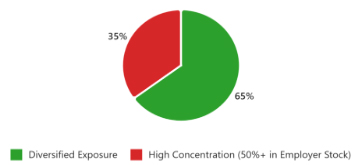
Graph showing: More than 35% of executives hold at least half of their net worth in employer stock (Schwab Equity Compensation Report). Suggested visualization: Pie chart or bar graph showing “High Concentration (50%+ in employer stock)” (35%+) vs “Diversified Exposure” to illustrate how common unintentional concentration becomes among executives.
A wealth reset helps you pause long enough to see the full picture. It helps you ask whether exposure still fits your goals or whether optimism around upcoming data delayed diversification. Control begins by ensuring that your concentration is intentional and connected to your long-term plan, not to the emotions of a moment.
A Brief Story: When Concentration Became the Silent Risk
Several years ago, we worked with a biotech VP who cared deeply about the science he spent more than a decade helping bring forward. His equity felt personal because it represented years of belief, effort, and commitment. Over time, however, grants and vesting events accumulated faster than he realized. His exposure climbed well past half of his net worth, yet he felt comfortable because an important data readout was approaching.
When the results fell short of expectations, the stock price dropped sharply. His financial foundation, once something he trusted, felt unexpectedly fragile. During his first wealth reset at TQM, we walked gently through how the concentration had built up. We helped him understand the emotional weight he had placed on a single milestone and why the risk had stayed hidden.
Together, we rebuilt his Critical Path®, created diversification rules that aligned with future vesting, and shaped a liquidity plan that supported both his goals and his family. Six months later, he told us that he finally felt calm. The stock price had not recovered, but he felt grounded again because his plan was no longer tied to one outcome. It was built around his life.
Stories like this remind us that control is not about perfection. It is about awareness, clarity, and support.
Coordinate Equity and Tax Decisions
RSUs, options, bonuses, and milestone payouts often create unpredictable tax outcomes — a theme that aligns with broader tax planning insights discussed elsewhere. A year that looks straightforward at the beginning can become a year of unexpected obligations when several events stack together. Without coordination, it can feel overwhelming.
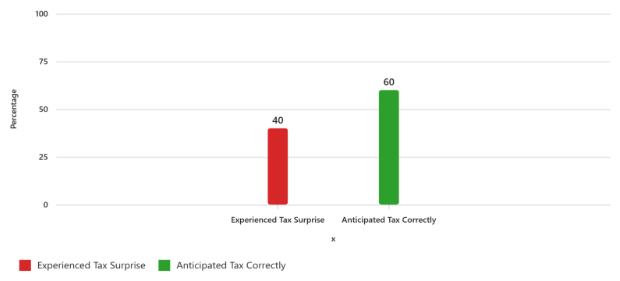
Graph showing: Nearly 40% of equity holders were surprised by their tax bill after vesting or exercising (American Institute of CPAs). Suggested visualization: Bar chart showing “Experienced Tax Surprise” (40%) vs “Anticipated Tax Correctly” (60%) to highlight the coordination gap that creates unnecessary stress.
A wealth reset helps you view these decisions through one lens. You look at how vesting is aligned with your cash reserves. You consider whether exercises need to occur in the same calendar year staggered over several years. You prepare for future vesting events based on the direction of your CriticPath so next year’s tax exposure does not create stress or urgency.
Control grows when decisions are planned and predictable. When equity vests, tax planning happens. When income spikes, withholding adjusts itself. When an exercise is considered, you analyze timing well before deadlines. The entire system becomes calmer and more structured.
Balance Liquidity and Opportunity
Biotech careers are dynamic. Companies reorganize. Programs shift. Funding cycles tighten. Roles evolve. These transitions make personal liquidity more important than many executives expect.
The JP Morgan Household Finance Study found that high income professionals with at least six months of liquidity experienced significantly better outcomes during periods of career transition. Liquidity reduces forced decision making and gives you space to choose your next step with clarity rather than urgency.
A wealth reset helps you assess whether your liquidity supported you this year. If delayed bonuses or a softer data cycle made things feel tight, next year’s plan may need to increase your personal runway. Liquidity is not about caution. It is about choice.
Create Systems That Reduce Cognitive Load
Executives in biotech carry heavy mental loads. Clinical timelines, board meetings, regulatory updates, investment discussions, and team responsibilities fill every week. When work accelerates, memory-based financial decisions become harder to manage.
Simple systems help protect your attention:
- When equity vests, you sell a specific percentage and reinvest toward long-term goals.
- When the fourth quarter begins, you schedule tax-loss harvesting and charitable planning.
- When options approach expiration, you run exercise analysis early instead of reacting later.
The Harvard Business Review has found that leaders who reduce decision fatigue through structured systems experience higher performance, lower stress, and greater overall clarity.
A wealth reset helps you identify which decisions can be automated and which require conversation. Systems create space for you to lead without carrying financial stress alongside professional pressure.
Why This Matters for Biotech Executives
Your work carries enough uncertainty. You manage science, teams, markets, milestones, and timelines that shift constantly. Adding financial uncertainty on top of all of that creates invisible pressure. When your equity, taxes, and liquidity are structured around your life and your goals, something important happens. The weight lifts.
One executive we worked with had RSUs vesting quarterly in meaningful amounts. He consistently delayed diversification because he believed the upcoming data would be strong. When the data was disappointing, his net worth dropped quickly. During his first wealth reset, we worked together to rebuild his system with clear diversification rules. A year later, he told us that he felt more grounded and more in control of his life, not because the stock had fully recovered, but because he had a plan that supported his family instead of a plan that relied on hope.
Control is not about eliminating risk. It is about choosing risk thoughtfully and managing it with confidence.
A Wealth Reset That Restores Order
Complex financial lives require care, structure, and intentional review. A wealth reset brings scattered decisions back into alignment. It integrates equity and taxes. It aligns your exposure to your Critical Path®. It shifts uncertainty into clarity. With a semi-annual review, your plan becomes stronger, steadier, and more connected to your life.
Soft CTA
TQM Wealth Partners helps biotech leaders bring order to the most complex areas of their financial lives. When your equity, taxes, and liquidity follow a plan built around your values, control returns and peace of mind follows.
Book a Meeting
Connect with our team to explore how a wealth reset can bring clarity and control to your equity, taxes, and long-term planning.