
Knowing When It’s the Right Time to Sell Your Business
A step-by-step guide for women founders
By Marcel V. Quiroga, CEPA® | RMA®
Founder & CEO, TQM Wealth Partners
Originally published in Enterprising Women Magazine (Spring 2026)
One of the questions founders ask me most is:
How do I really know when it’s time to sell my business?
For women founders and CEOs—especially those leading businesses with $5 million to $25 million or more in revenue—the answer is rarely just about valuation multiples or market conditions.
Those factors matter. But in my experience as a fiduciary wealth manager, the most confident exits start somewhere else.
They start with personal clarity.
What follows is a practical, repeatable framework to help you determine whether selling your business truly makes sense—for your life, not just your company.
Step 1: Reframe the Question
The most important shift is this:
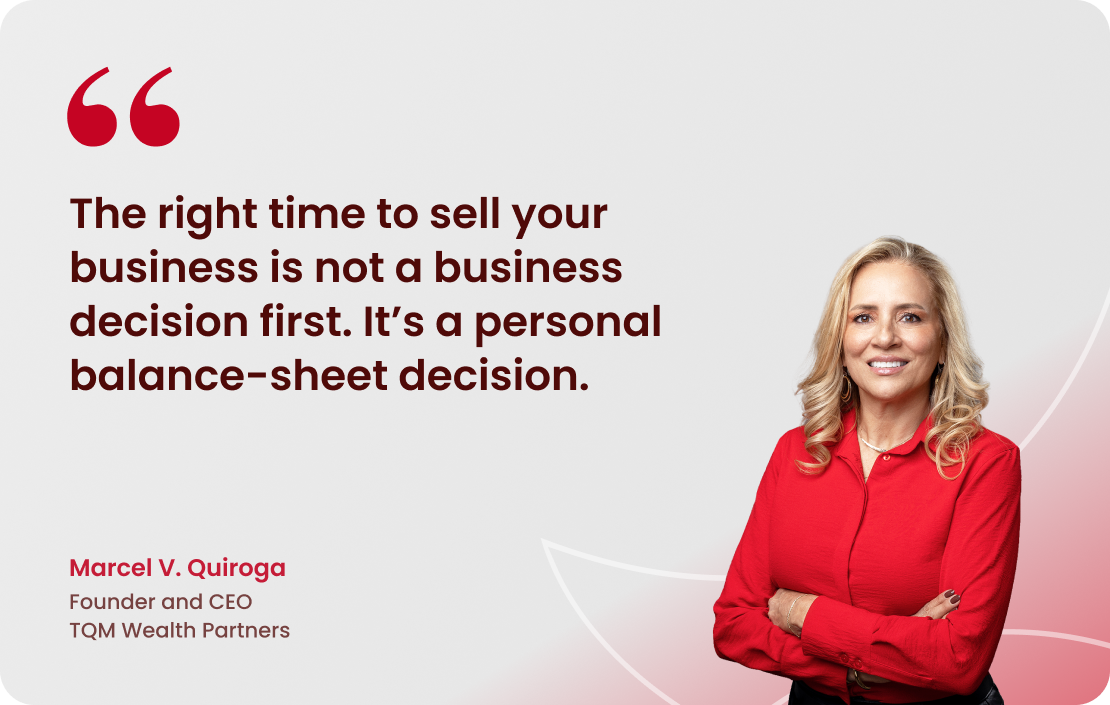
The right time to sell your business is not a business decision first. It’s a personal balance-sheet decision.
Too many founders begin by asking:
What could I sell my business for?
Instead of asking:
What do I actually need my life to cost?
Until you answer the second question, every offer will feel emotional, uncertain, or never quite enough.
Step 2: Treat Your Future Lifestyle as a Liability
Here is a concept that often stops founders in their tracks:
Your future lifestyle is a financial liability.
Every dollar you expect to spend for the rest of your life, housing, healthcare, travel, family support, philanthropy, and freedom—is money you owe your future self.
Not emotionally.
Financially.
When you add up your current spending, future needs, and long-term goals—and translate them into today’s dollars—you arrive at a real number.
That number belongs on the liability side of your personal balance sheet.
Most founders have never calculated it.
They simply assume the business will be “enough.”
Hope is not a strategy.
Step 3: Inventory All Your Sources of Capital
Once you understand what your life will cost, the next step is to determine what’s already working to fund it.
As a fiduciary, I evaluate four forms of capital—each translated into today’s dollars:
- Financial capital: Savings and investments outside the business
- Human capital: Future earning potential if you continue working
- Social capital: Social Security income, modeled realistically over time
- Other capital: Income from rental properties, royalties, licensing, or other cash-flow assets
When you map these sources clearly, you begin to see how much of your future lifestyle is already funded—and what remains uncertain.
Step 4: Identify the Gap
The difference between:
- what will your future life cost, and
- what your existing capital can fund
is the gap.
This gap defines what your business must ultimately provide.
One of the most common mistakes founders make at this stage is confusing business value with life-funding value.
A headline sale price is not the same as spendable wealth.
After-tax reality, the loss of income once you stop working, and the sustainability of post-sale income all matter.
Ignoring these factors can turn what appears to be a successful exit into a long-term shortfall.
Step 5: Learn from Two Very Different Outcomes
Case Study #1: When Business Value Exceeds the Gap
A 52-year-old founder running a $10 million revenue company calculated that her future lifestyle required $7 million in today’s dollars.
Her investments, anticipated consulting income, Social Security, and rental income totaled $5.5 million, leaving a $1.5 million gap.
When she received an acquisition offer of $10 million, the after-tax proceeds comfortably filled the gap and created a cushion.
She exited with clarity and confidence knowing the business had fulfilled its role.
Case Study #2: When Business Value Falls Short of the Gap
Another founder, age 48, led a $5 million revenue business and felt emotionally ready to sell.
She assumed $6 million would be sufficient.
But her future lifestyle required closer to $8 million. Her non-business assets totaled $2.8 million, and she planned to stop working after the sale.
A $6 million transaction would likely net closer to $4 million, leaving a meaningful shortfall.
Instead of exiting prematurely, she focused on increasing business value. A few years later, she sold at a higher valuation and fully funded her future.
In her case, clarity did not delay freedom, it prevented regret.

Common Mistakes That Derail Otherwise Strong Exits
Even highly successful founders fall into predictable traps:
- Letting the market decide for you: A “hot” market does not guarantee personal readiness
- Selling during burnout: Exhaustion leads to reactive decisions
- Ignoring human capital: Your business may also be your primary income source
- Underestimating longevity: Longer lifespans require more thoughtful planning
- Treating exit planning as a one-time event: Your life and business will evolve—your plan should too
Avoiding these mistakes is not just about achieving a better exit.
It’s about building a stronger business today.
Step 6: Exit Planning Is Smart Business Planning
Exit planning isn’t about leaving, it’s about building optionality.
Founders who plan early tend to:
- Improve cash flow
- Reduce risk
- Strengthen leadership
- Increase flexibility
Ironically, the more intentional you are about exit planning, the more valuable—and often more enjoyable—your business becomes.
Final Thought: Know Your Number
The right time to sell your business is not when the market peaks.
It’s when your personal balance sheet tells you you’re ready.
If you are a founder over 40, one of the most valuable steps you can take today is to determine your number—and begin planning now.
Not because you are leaving, but because it is sound business strategy.
When business value and life value are aligned, selling your business becomes a strategic decision—not an emotional one.
And that is how founders exit on their own terms.
A Note from TQM Wealth Partners
At TQM Wealth Partners, we work with founders as a fiduciary Personal CFO, helping define the financial independence threshold, coordinate all sources of capital, and align every decision—before, during, and after a liquidity event.
If you are approaching a potential exit and want clarity around what your business should deliver for your life, we invite you to begin that conversation with our team.